MedStream.global is currently in Beta version for development and partnership purposes.

The Panic Industry: Deconstructing the Attention Economy and Crime Amplification in the Digital Media Landscape

The contemporary media landscape is undergoing a profound structural transformation, moving far beyond its classical role of news transmission or public awareness. It has mutated into a system fundamentally rooted in the “commodification of anxiety” and the redirection of collective consciousness toward shock and polarization. The recurrent dominance of crime stories and tragic incidents across platform screens and social networks is not an editorial coincidence; rather, it is the result of a calculated strategy driven by precise economic and algorithmic incentives designed to exhaust the recipient’s attention.

1. The Economic Perspective: The Attention Economy and the Digital Business Model

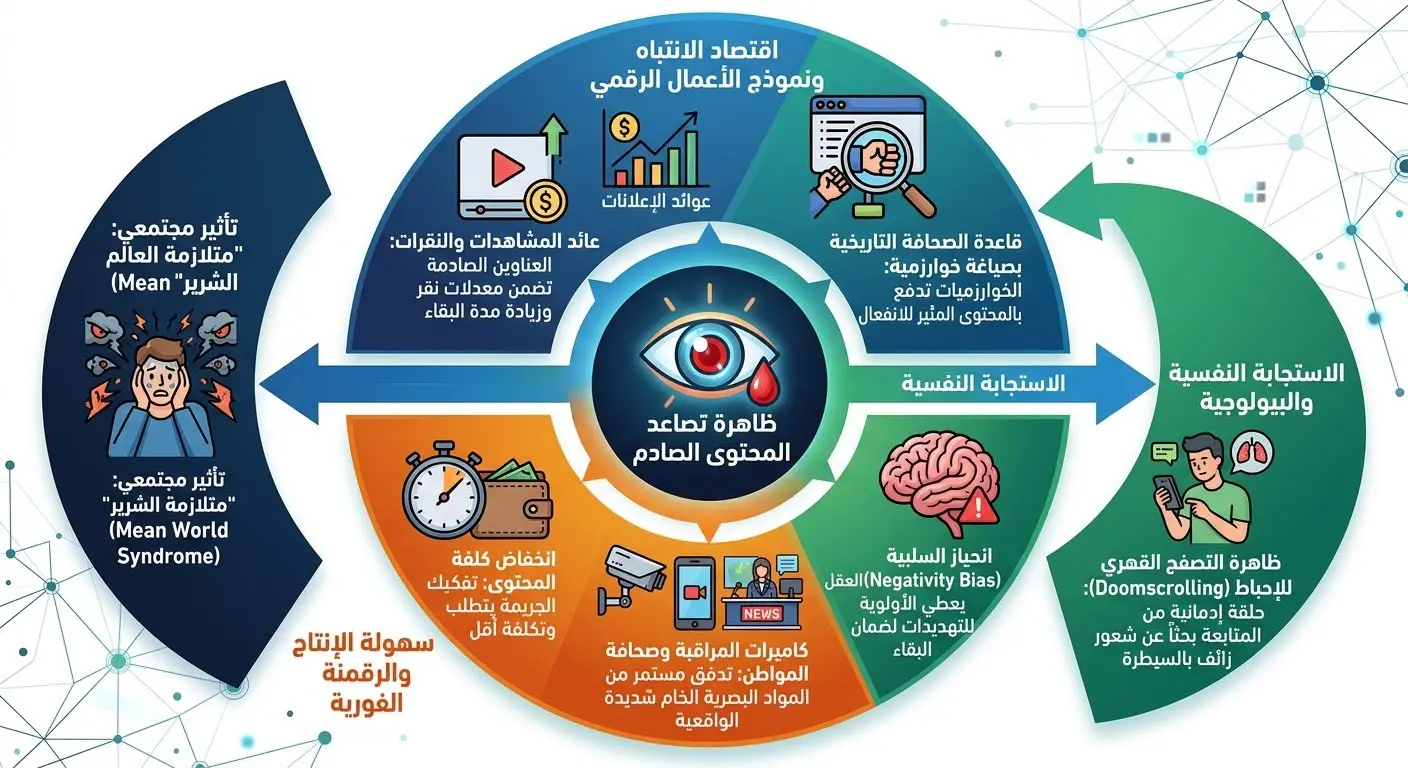
  • Maximizing Click-Through Rates (CTR): Balanced news or calm analyses do not trigger immediate responses, whereas headlines charged with shock and threat provoke an urgent curiosity that exponentially multiplies engagement and sharing rates.
  • Algorithmic Alliance with Excitement: Recommendation algorithms capture intense emotional reactions (anger, fear, outrage) and prioritize them in news feeds, making the dissemination of crime content the most profitable behavior and the fastest path to dominating platforms.
  • Cost Efficiency and Rapid Production: Producing in-depth investigative content or economic institutional analysis requires massive financial and research resources, whereas criminal details and surveillance footage provide ready-made, low-cost media material with high commercial returns.

2. Structural Comparison: The Impact of Media Production

AxisSensationalist & Crime-Hunting MediaSober & Analytical Media
Primary DriverTriggering fear, shock, and maximizing rapid viewsAwareness, structural context, and cognitive value
Operational CostExtremely low (recycling clips and police report details)High (investigation, data verification, research competencies)
Societal ImpactErosion of trust, Mean World Syndrome, and security anxietyBuilding critical awareness, stability, and social responsibility
Targeted ResponseInstinctive, non-critical emotional engagementRational understanding and comprehension of causes/solutions

3. Behavioral and Social Dimensions: Engineering Public Perception

  1. Exploiting Instinctive “Negativity Bias”: The human brain inherently tends to monitor threats in search of survival; this biological readiness is exploited in reverse, trapping the reader in endless cycles of compulsive browsing.
  2. Cementing the “Mean World Syndrome”: Continuous visual feeding on individual accidents creates a false impression that society is on the verge of chaos, raising mutual suspicion and undermining social cohesion.
  3. Displacement of Crucial Issues: The dominance of criminal incidents sidelines genuine discussions related to economic transformations, development, governance, and capacity building, replacing them with transient, consumerist debates.

Conclusion and Analytical Vision

The current media focus on exporting crime does not necessarily reflect a real increase in its statistical rates; rather, it reflects the crisis of the media business model and its subordination to commercial interaction algorithms. Confronting this vortex requires critical awareness from the recipient to sort content and distinguish between what adds real value to awareness and what is crafted for the purpose of profiting from the excitation of collective anxiety.

Dr. Asmaa Najjar | Economic Researcher & Analyst

More questions?

Let’s talk.

Our customer support team is experienced in supporting your translation needs.

Contact Us

Select your currency
USD United States (US) dollar
WhatsApp
MedStream Logo